Materials: AI Adoption and Maturity
Chemicals, metals, mining, and packaging companies applying AI to process optimization, yield, and sustainability.
The AIDE Matrix — Materials
Strategic Intent runs along the x-axis and Operational Integration along the y-axis, with bubble size proportional to revenue. Companies fall into four quadrants: Trailblazers (top-right), Stealth Adopters (top-left), Visionaries (bottom-right), and Emerging Adopters (bottom-left). How to read the AIDE Matrix.
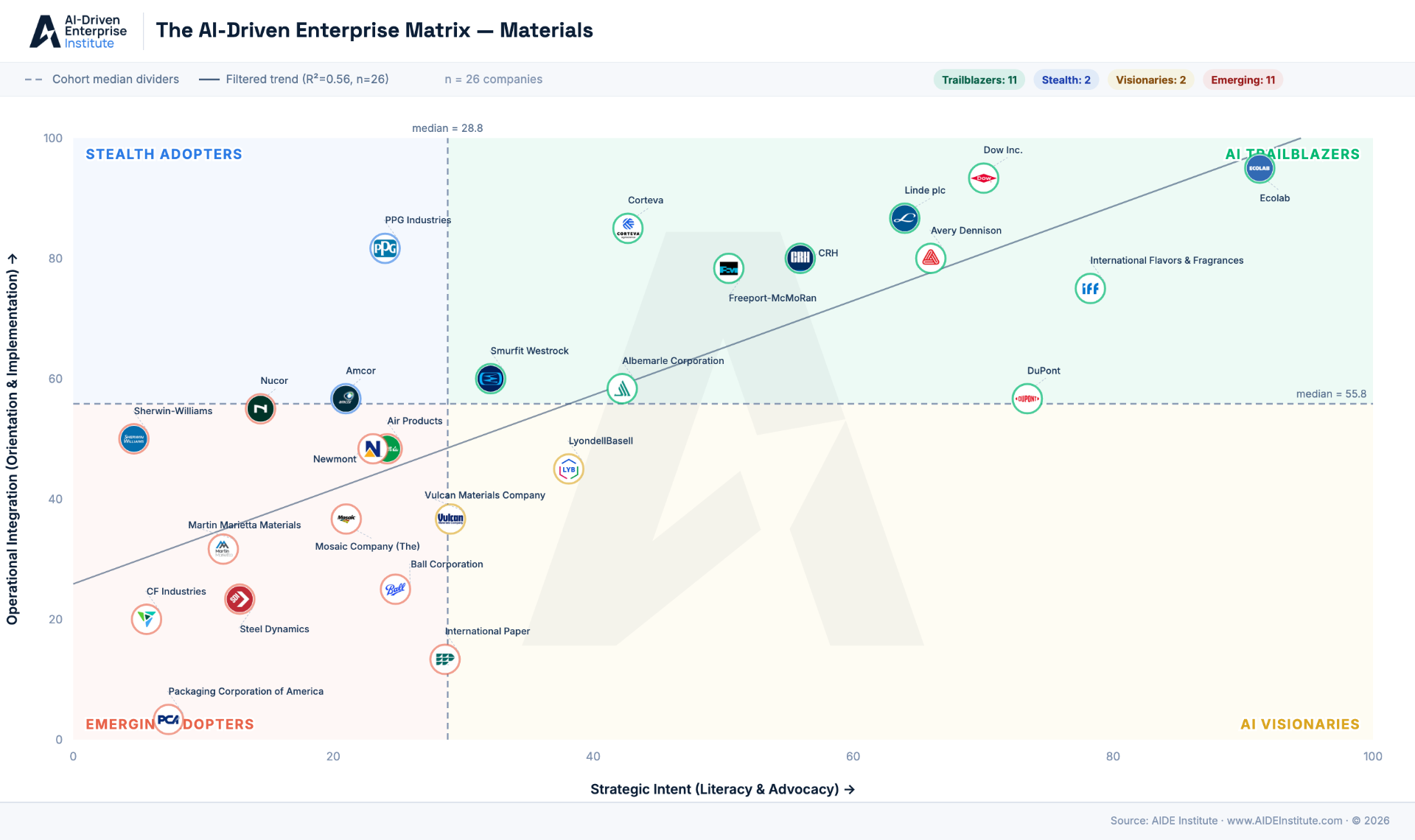
The AIDE Index measures how comprehensively each S&P 500 company has integrated artificial intelligence across leadership and operations. Companies are positioned within their industry, not across the full S&P 500, so that comparisons reflect peer-group context.
The AIDE Index is built from publicly available evidence using a consistent methodology across the S&P 500. Learn more about our methodology.
How companies in Materials are using AI
Materials companies disclose AI use in process control, yield and quality inspection, energy consumption in heavy conversion, and logistics for bulk shipment. AIDE draws on annual reports, plant-level announcements and confirmed technology partnerships.
Because much of the sector sells commodity inputs, AIDE weighs plant and supply-chain evidence more heavily than product evidence when reading the Materials record.
The Materials evidence review is complete but still in audit. Patterns, functional areas and examples publish here once they have been checked line by line, so nothing unverified appears in the meantime.
How AIDE documents AI useWhich Materials companies, and where the AI sits
Company-level entries publish here as each sector clears audit. A company is named only when the evidence comes from a source the company itself has published and posted.
Materials companies — full ranking
Click any column header to sort.
| 1 |  | ECL | Specialty Chemicals | 93.1 | Materials AI Trailblazer | 91.3 | 95 | 82.6 | 100 | 90.0 | 100 |
| 2 |  | DOW | Commodity Chemicals | 81.7 | Materials AI Trailblazer | 70.0 | 93.3 | 93.1 | 47 | 100 | 86.7 |
| 3 |  | IFF | Specialty Chemicals | 76.6 | Materials AI Trailblazer | 78.3 | 75 | 100 | 56.5 | 70 | 80 |


Company Logo Sourced From: logo.dev
Questions about this sector, the AIDE Index, or our methodology?
Contact the AIDE InstituteMethodology & Data Integrity
The AIDE Index methodology is governed by four foundational commitments.
Independent Sources, Public Data
All inputs derive from publicly available signals: patent databases, annual reports, earnings call transcripts, job postings, corporate sites, LinkedIn, and AI Research Agent queries across news, SEC filings, industry publications, and case studies. No data point requires voluntary disclosure from the assessed company.
Comparability Across the Cohort
Every S&P 500 company is assessed with identical collection protocols, scoring rubrics, and normalization procedures. Cohort-based min-max normalization ensures scores reflect relative positioning, enabling meaningful cross-company and cross-sector comparisons.
Multi-Dimensional Measurement
AI maturity is not a single attribute. The AIDE framework separates what leaders know and communicate (Leadership) from what the organization prioritizes and builds (Company), revealing alignment, or misalignment, between strategic intent and operational reality.
Transparency and Auditability
Every score can be traced from the final AIDE Index back through normalized scores, raw dimension scores, channel-level signals, and individual data points. Multi-LLM cross-validation and human-in-the-loop review provide the audit mechanism for non-deterministic components.