
Industrials: AI Adoption and Maturity
Capital goods, transportation, and commercial services applying AI to operations, logistics, and field workforces.
The AIDE Matrix – Industrials
Strategic Intent runs along the x-axis and Operational Integration along the y-axis, with bubble size proportional to revenue. Companies fall into four quadrants: Trailblazers (top-right), Stealth Adopters (top-left), Visionaries (bottom-right), and Emerging Adopters (bottom-left). How to read the AIDE Matrix.
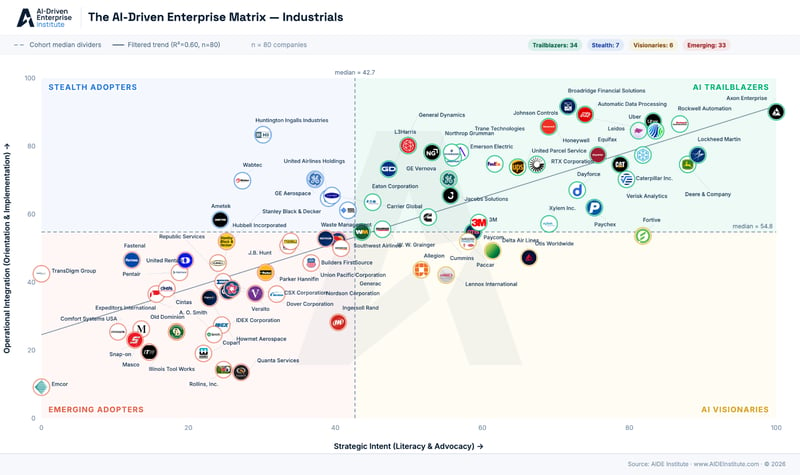
The AIDE Index measures how comprehensively each S&P 500 company has integrated artificial intelligence across leadership and operations. Companies are positioned within their industry, not across the full S&P 500, so that comparisons reflect peer-group context.
The AIDE Index is built from publicly available evidence using a consistent methodology across the S&P 500. Learn more about our methodology.
How companies in Industrials are using AI
Industrials evidence review has not started. Nothing is published for this sector yet.
Industrials will be added once its source review is complete and audited.
Sector-level evidence for Industrials is not published yet. The AIDE review for this sector has not started, and nothing is shown here until it has been completed and checked.
How AIDE documents AI useWhich Industrials companies, and where the AI sits
Company-level entries publish here as each sector clears audit. A company is named only when the evidence comes from a source the company itself has published and posted.
Industrials companies – full ranking
Click any column header to sort.
| 1 |  | AXON | Aerospace & Defense | 95.0 | Industrials AI Trailblazer | 100 | 90.1 | 100 | 100 | 85.7 | 94.4 |
| 2 |  | ROK | Electrical Components & Equipment | 86.7 | Industrials AI Trailblazer | 86.9 | 86.5 | 96.8 | 76.9 | 78.6 | 94.4 |
| 3 |  | UBER | Passenger Ground Transportation | 85.3 | Industrials AI Trailblazer | 83.3 | 87.3 | 87.5 | 79.0 | 85.7 | 88.9 |


Company Logo Sourced From: logo.dev
How Industrials companies are using AI
Documented public evidence of AI use in this sector, each one pointing to the source behind it.
3M
3M Digital Materials Hub – generative AI for material science collaboration
Description
The expanded 3M Digital Materials Hub combines generative AI, advanced modeling, and 3M's material-science expertise to let engineering teams collaborate with 3M scientists, work with advanced optical models, and request virtual materials that do not yet exist. It is positioned as a platform that compresses the path from problem statement to concept to digital validation, reducing iterations and prototyping cost in product development workflows.
Capability: AI-native product features
- Business function:
- R&D
- Deployment context:
- In products and services
- Deployment status:
- Deployed
- Public evidence:
- Shown running
- Business benefit:
- Creates new value
- Evidence year:
- 2026
3M
AI agent for sales pipeline coaching analysis
Description
3M deployed an AI agent that analyzes sales and opportunity pipeline data to develop customized coaching plans for sales managers to help reps meet their targets, as described in the Q1 2026 earnings call.
Capability: Agent assist and case intelligence
- Business function:
- Sales
- Deployment context:
- In day-to-day operations
- Deployment status:
- Deployed
- Public evidence:
- Partly evidenced
- Business benefit:
- Removes cost
- Evidence year:
- 2026
3M
AI agent-driven customer order management with Microsoft Frontier
Description
As part of the 3M–Microsoft strategic partnership, Microsoft's Frontier Company team is embedding engineers within 3M's Global Business Services to automate customer order management. The collaboration uses an AI agent-driven workflow with human-in-the-loop controls and a custom monitoring dashboard to handle credit checks, delinquency assessments, and system updates in real time, with the stated goal of cutting manual effort, improving consistency and accelerating cash flow.
Capability: Document and workflow automation
- Business function:
- Shared services
- Deployment context:
- In day-to-day operations
- Deployment status:
- Piloted
- Public evidence:
- Partly evidenced
- Business benefit:
- Removes cost
- Evidence year:
- 2026
Questions about this sector, the AIDE Index, or our methodology?
Contact the AIDE InstituteMethodology & Data Integrity
The AIDE Index methodology is governed by four foundational commitments.
Independent Sources, Public Data
All inputs derive from publicly available signals: patent databases, annual reports, earnings call transcripts, job postings, corporate sites, LinkedIn, and AI Research Agent queries across news, SEC filings, industry publications, and case studies. No data point requires voluntary disclosure from the assessed company.
Comparability Across the Cohort
Every S&P 500 company is assessed with identical collection protocols, scoring rubrics, and normalization procedures. Cohort-based min-max normalization ensures scores reflect relative positioning, enabling meaningful cross-company and cross-sector comparisons.
Multi-Dimensional Measurement
AI maturity is not a single attribute. The AIDE framework separates what leaders know and communicate (Leadership) from what the organization prioritizes and builds (Company), revealing alignment, or misalignment, between strategic intent and operational reality.
Transparency and Auditability
Every score can be traced from the final AIDE Index back through normalized scores, raw dimension scores, channel-level signals, and individual data points. Multi-LLM cross-validation and human-in-the-loop review provide the audit mechanism for non-deterministic components.