This week’s reported gains came from contract review, customer care, code deployment, grid planning, and clinical-research paperwork.
The AIDE Institute tracks how S&P 500 companies are using AI, based on public evidence, and adds to the record every week.
Five AI deployments worth a closer look
This update includes 122 new applications from 71 companies and 173 changes to previously documented initiatives. Of the new applications, 60 support internal operations and 62 appear in products and services.
T-Mobile: AI agents in customer care
- Application: AI agents on the IntentCX platform handle customer contacts.
- Reported figure: AI agents handle 40% of customer contacts. Human-handled care calls are down 55%.
- Read carefully: The 55% is the reported reduction in human-handled care calls, and the company’s 75% figure is a goal for the end of 2027.
- Source: Fierce Network
Booking Holdings: AI-assisted code deployment
- Application: Engineers use AI tools when raising merge requests that reach production.
- Reported figure: About 9,000 technologists put about 30% more code into production.
- Read carefully: The 30% describes code reaching production, not a reported reduction in engineering cost.
- Source: Fortune
Edison International: physics-based grid planning
- Application: An Edison International unit studied constrained grid capacity with GridCARE using physics-based AI.
- Reported figure: The initial study identified potential 20 MW of flexible grid capacity on a constrained Inland Empire circuit.
- Read carefully: Utility engineers validate scenarios before approval, and the figure is potential capacity from the study.
- Source: Daily Energy Insider
Reported by the company or its vendor
The next two come from company reports. Read the results as the companies’ own account.
Uber: Legal Redlining contract review
- Application: Uber’s Word-integrated Legal Redlining AI agent supports contract review.
- Reported figure: Uber reports contract review time fell more than 20%. The agent reached 91% accuracy on accept, reject, and modify recommendations.
- Read carefully: Both figures are Uber’s reported measures for its agent and lawyer-feedback workflow.
- Source: Uber
Thermo Fisher: clinical consent drafting
- Application: Thermo Fisher uses generative AI to draft consent forms in its PPD clinical research business.
- Reported result: Thermo Fisher reports consent-form drafting time is halved. In some studies, site enrollment and activation activities fell 15-30%.
- Read carefully: The 15-30% range applies to some studies, not every clinical-research workflow.
- Source: Thermo Fisher via BioSpace
Activity by sector
Information Technology led this update, followed by Health Care, Consumer Discretionary, and Industrials.
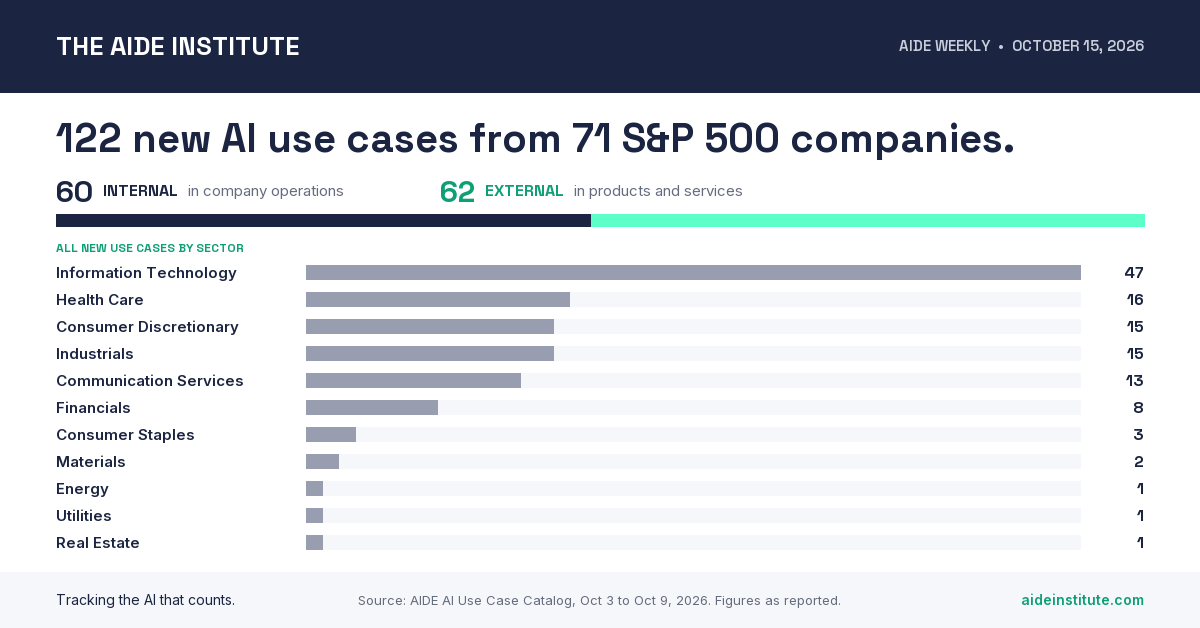
| GICS sector | New | Updated | Total activity (computed) |
|---|---|---|---|
| Information Technology | 47 | 91 | 138 |
| Consumer Discretionary | 15 | 23 | 38 |
| Communication Services | 13 | 20 | 33 |
| Financials | 8 | 17 | 25 |
| Health Care | 16 | 8 | 24 |
| Industrials | 15 | 9 | 24 |
| Consumer Staples | 3 | 4 | 7 |
| Materials | 2 | 0 | 2 |
| Energy | 1 | 1 | 2 |
| Utilities | 1 | 0 | 1 |
| Real Estate | 1 | 0 | 1 |
What to take from this update
- T-Mobile and Uber report figures tied to a specific unit of work: customer contacts and contract review.
- Booking Holdings reports more code reaching production, while Thermo Fisher reports less drafting time.
- Edison International’s study reports potential capacity, subject to utility-engineer validation.
Method note
This update covers cases added from October 3 through October 9. An application is included when a company or credible public source describes a specific use of AI. Production status and recorded results reflect the public evidence available at the time of review.
Compiled from public sources and may contain errors. Figures are as reported by companies and their vendors and have not been independently verified.